


Select any question to see the answer.
How do my lawn and garden care choices affect the amount of jellyfish in the two rivers?
— by Kristen Rolfes Hall
As the summer months progress, many boaters and swimmers notice an increase in jellyfish in our local waters. While jellyfish have been around for hundreds of millions of years, they do not always proliferate so dramatically. Increased algae in the waters contribute to changes in the ecosystem that create advantageous odds for our stinging friends. Fish and jellyfish compete for the same resources and usually this balance keeps numbers of both at favorable levels. An increase in algae growth tilts the balance by depleting the oxygen in the waters. Fish die off, but jellyfish can survive in these low oxygen (hypoxic) waters and thrive with the remaining abundance of food and lack of predators.
What homeowners may not realize is that our planting and lawn care choices are contributing to the problem. Algal blooms are amplified by the combination of unusually warm weather and the misuse of fertilizers. Just as the fertilizers help grass, plants and crops flourish, they also find their way into local waters and promote the growth of algae. Algal blooms disrupt the ecosystem by choking out wildlife in local rivers and streams and lead to poor water quality, declining fish and shellfish populations, and an overabundance of jellyfish in our rivers, oceans and bays.
You can help by choosing the appropriate lawn care practices for your home or business. A healthy lawn does not require as much fertilizer as one that is stressed. Below are five ways you can alter your lawn care practices in support of healthier rivers.
-
Only fertilize your lawn if there is no rain in the forecast.
Fertilizer needs two days to properly absorb. Instead of soaking into the soil where it can nourish your lawn, the fertilizer is likely to simply wash away with the stormwater and find its way to local waterways if applied when rain is predicted. -
Once established, only fertilize your lawn in the fall.
Extension, “fertilizing your lawn late in the season (September through November) the previous year reduces or eliminates the need for fertilizer in the spring, reduces frequency of mowing, and improves drought resistance.” Fertilizing in the fall allows the roots system to establish while spring fertilizing promotes top growth, which requires more frequent mowing and can actually stunt root growth, undermining resilience. -
Be careful not to overwater your lawn.
Most New Jersey lawns only require a thorough watering once or maybe twice a week during the summer months. Anything more is excessive and can undermine the health of your lawn. The most efficient time to water is between 10pm and 8am when the heat of the day will not evaporate the water before it is allowed to penetrate through the soil to the root system. Sprinkler systems should be fitted with a rain sensor to prevent your system from watering when it has just rained. -
Proper mowing practices can help maintain a healthy lawn.
Maintaining a mowing height of 2½ to 3½ inches will help increase drought resistance and will decrease insects and disease damage. Allowing grass clippings (comprised mostly of water) to remain on your lawn after mowing is beneficial. The clippings decompose quickly and provide nutrients that will nourish the soil and root system.
Share these tips with your lawn maintenance provider. Unfortunately, fertilizers are cheap and easy to apply and many landscapers have no incentive to recommend better lawn care practices. Proper use of fertilizers, watering techniques, grass variety and ground cover will not only reduce our negative impact on our environment, it will promote a more healthy and beautiful lawn and garden. For a more detailed discussion see the guidelines recommended for New Jersey lawns by the Rutgers Cooperative Research & Extension found at http://njaes.rutgers.edu/pubs/publication.asp?pid=FS102.
Download a PDF of this answer here.
What are microplastics and how do they affect us and our environment?
— by Jody V. Sackett
In the hundred years that plastics have been around, they have become ubiquitous. Microplastics, the polymers that are 5 millimeters or less in size, are now found just about everywhere in our environment, including the food we eat, the water we drink, and the air we breathe. They come from one of two sources: either from a larger plastic item that has broken down into smaller pieces, or they were initially manufactured as a tiny polymer for use in consumer products.
Consumer plastics vary in type and although there are about six common types, we currently only recycle three types in Rumson. They can be identified by the numbers 1, 2 & 5 inside a triangle stamped on the item. Probably one of the most common is polyethylene terephthalate (PET or #1), which is used to make soda and water bottles, peanut butter containers, condiment bottles and the like. Milk jugs, detergent & shampoo bottles, are all made from high density polyethylene (HDPE or #2). Bottle caps, straws, yogurt containers, and food containers are made of polypropylene (PP or #5). Other types of plastics including styrofoam, straws, toys, plastic bags, PVC pipe and cereal box liners are not as easily recycled.
All of these plastic items, like most polymers, take a very long time to degrade. A plastic grocery bag takes 20 years to decompose; nylon fabric takes 30-40 year; styrofoam cups take 50 years; disposable diapers and water bottles take 450 years; and monofilament fishing line takes 600 years.
With such a long life, plastics have plenty of time to break down into smaller and smaller micro-pieces. Heat, sunlight, harsh weather, and mechanical wear-and-tear weaken the polymers to break into small fragments which do not biodegrade quickly. Microplastics can also come from plastic “dust” during construction or industrial processes, and even from rubber tires that emit fine polymer particles as they wear down on the roads. This all enters our bodies through the food we eat (which may have ingested the polymers first), the water we drink, and through the miniscule polymer particles in the air we breathe. It’s been estimated that a credit-card’s weight worth of microplastic enters our bodies every week.
Manufactured microplastics include microbeads and nurdles. Polyethylene microbeads were actually created as microplastics for use in toothpastes, facial scrubs and many other personal-care products. Smaller than a sand grain, they enter the waterways and oceans easily, because many water-treatment facilities are unable to filter the tiny pieces out. While the use of microbeads is prohibited by law now, they still exist due to the long life of plastics and will be around for hundreds of years to come.
Nurdles are resin pellets of plastic material, about the size of a lentil. Typically, recycled plastic is cleaned and then reformed into long thin rods which are then cut into tiny pieces called nurdles; these pieces are then melted by manufacturers to make new plastic products. Nurdles can be found on our local beaches and waterways in many colors, and often exhibit signs of significant abrasion. They are extremely long-lasting and may enter the environment through loss during transportation or transfer. Wind and ocean currents can spread nurdles world-wide.
Plastics are both a boon and a curse. They are useful and universal in our cultures, from clothing to industrial products. Polymers can be essential and save lives as medical assets. Unfortunately, many are items that are used once and then discarded; yet their polymer structure causes them to be extremely durable, so that they do not just disappear once discarded, but remain in the environment for decades or centuries. Plastics also impact ocean life in various ways. Marine animals caught in plastic netting or consumer products are directly affected as they become trapped in the debris, with decreased mobility and function. Marine animals can consume nurdles and other microplastics intentionally, thinking they are tasty eggs or larvae, or accidentally when they ingest the plastics along with other foods. But polymers decompose slowly, so microplastics may remain in the digestive systems for a long time, resulting in malnutrition and starvation.
Various solutions are available for both individual and community use. Recycling of plastics into other polymer items such as insulation, furniture, and consumer goods is a viable option for controlling discarded plastics, although success rates vary widely (some estimates are that only 9% of our trash is recycled due to contaminants and neglect). Creative engineering and chemical solutions are being developed to remove plastics directly from the water, or to reformulate polymers for faster degradation, such as adding a simple sugar to the polymer that attracts bacteria to eat it. Behavioral changes can make a big difference, such as refusing to use disposable plastic products like straws or wraps, and only using refillable bottles instead of single-use plastic ones; not only does this eliminate waste from the environment, but it reconfigures how our culture views and values disposable items overall. In November 2020, Governor Murphy signed Senate Bill 864 into law, which banned single-use plastic bags, Styrofoam products like takeout containers and meat trays, and plastic straws. This mandatory behavior change will provide long-term benefits by eliminating a major source of plastic litter, as well as reducing the need for fossil fuels to make these plastics in the first place.
Recycling, behavior changes, legislative bans, and especially education in schools, colleges, and through environmental groups can all promote awareness of the plastic problem and identify solutions. By individual commitment and community involvement, we can inspire responsibility and stewardship for the environment, and all work towards solving the plastic problem. Please explore this Rumson Environmental Commission website for more detailed information about related issues such as recycling, water quality and pollution.
Download a PDF of this answer here.
Why are native plants important and which ones would be suitable for my yard in and around Rumson?
— by Heather Robinson
Native plants are uniquely adapted to a specific region’s climate, soil type, and growing conditions. We are lucky in Rumson to have many beautiful native plants that are easy to maintain, provide year-round interest and habitat in the garden and can make our property more resilient. Here are a few of the many compelling reasons to include native plants in your landscape.
Native plants:
- SAVE MONEY. Native plants are stronger and more resilient than non-native plants and as a result are lower maintenance. They require less fertilizer and less pesticides to keep them looking beautiful.
- SAVE WATER. Native plants are naturally adapted to our local conditions and need less water to survive and thrive.
- HELP TO MANAGE STORMWATER RUNOFF. The root system of a native plant is three to five times deeper than non-natives. The stronger root structures will filter and absorb water as well as hold soil in place preventing erosion and improving water quality.
- SUPPORT A STRONG ECOSYSTEM: Non-native invasive species in your yard can squeeze out the native plants that support a healthy ecosystem. You can build a wildlife habitat by planting native plants that provide food and cover for beneficial birds and insects. Fostering these pollinators help all of the plants in your landscape.
Below are a few native plants to consider.
Ground Cover
Wild ginger (Asarum canadense): This attractive, low-growing ground cover is also deer resistant. It keeps its glossy leaves throughout the season and has an attractive dark red flower in spring. Many beneficial insects pollinate this plant, and its roots have traditionally been used as a substitute for ginger.
Bunchberry Dogwood (Cornus canadensis): Good for shaded areas, this plant has tiny greenish flowers in late spring through summer which are replaced by a cluster of bright red berries in fall. Bunchberry attracts butterflies and is deer resistant.
Flowering Perennials:
Orange Milkweed (Asclepias tuberosa): The caterpillars of Monarch butterflies rely on milkweed as their only source of food and the flowers are essential to native bees. These are perennial plants (meaning they will come back year after year) and can be purchased as plants or grown from seed. Blooms May-September.
Scarlet Bee Balm (Monarda didyma) or Cardinal Flower (Lobelia cardinalis): Ruby-throated hummingbirds love both of these elegant bright red flowers! Bee balm and cardinal flower are both hardy plants with showy perennial flower that will bloom May-October and can be purchased as a plant or grown from seed.
Purple Coneflower (Echinacea purpurea): These beautiful flowers attract pollinators all summer long, and in the fall, you may see goldfinches feasting on the seeds. Coneflowers are a perennial plant that will bloom from April to September, and can be purchased as a plant or grown from seed.
Shrubs:
New Jersey Tea/Redroot (Ceanothus americanus): Tiny bright white flowers in 2” clusters appear in spring, and this low shrub reaches about 3’ tall. It attracts a variety of birds and butterflies and was used to make a tea popular in the Revolutionary War period.
American Witchhazel (Hamamelis virginiana): This unique woody shrub shows off fragrant cream to yellow blooms in later fall/early winter. The late summer seeds are a food source for many birds and small animals and the oil has medicinal qualities. Reaching up to 30’ high and 25’ wide, this shrub can be found in many local nurseries.
Trees:
American Holly (Ilex opaca): Some of the oldest holly trees in the country can be found on Sandy Hook, so this species does especially well in our area. Many birds and small mammals eat the berries, while the tree provides shelter to birds as well. Holly shrubs and trees can be purchased at many local nurseries.
Red Oak (Quercus rubra): The Red Oak is the state tree of NJ, and oak trees in general are considered a keystone species (a species on which other species in an ecosystem largely depend, such that if it were removed the ecosystem would change drastically). Over 500 insects, 80 species of reptiles and amphibians, 100 birds and over 60 species of mammals rely on oak trees for habitat and food! Oak trees can be purchased at many local nurseries.
There are many ways to include these and other native plants into your property. They can be incorporated into existing garden beds or used to convert turf to a pollinator garden. If you are out of space some plants can even be grown in containers on a patio or porch. You have the power as an individual gardener to help build our local ecosystems!
Below are additional resources to help you find the right native plants for your space:
- Jersey-Friendly Yards: https://www.jerseyyards.org
- Rutgers NJ Agriculture Experiment Station Home & Garden: https://njaes.rutgers.edu/home-lawn-garden/
- Native Plant Society of NJ: http://www.npsnj.org/index.html
Download a PDF of this answer here.
How does green infrastructure protect fish in our rivers?
— by Jody V. Sackett
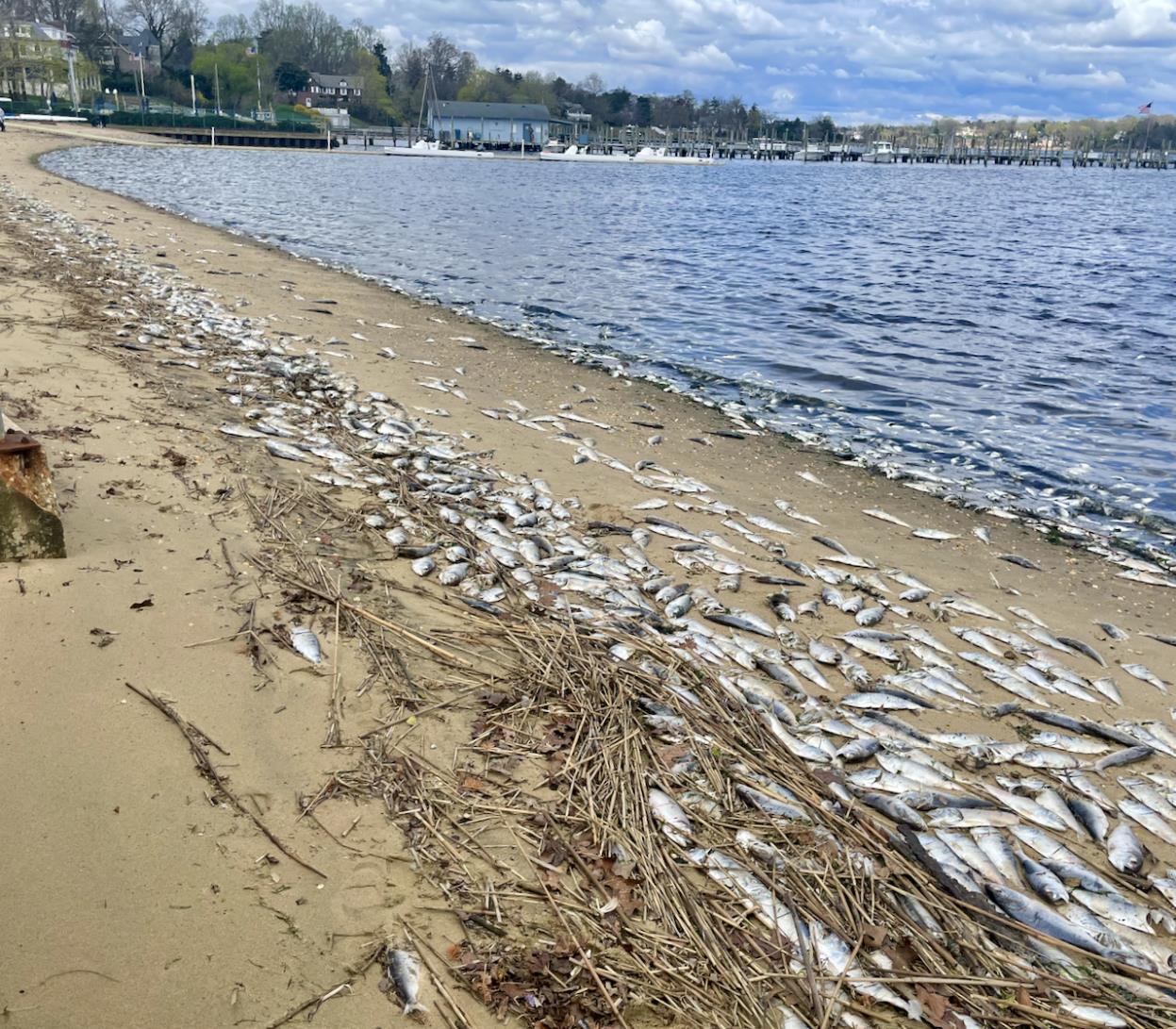 Thousands of fish floating on top of the water and washing up on the beach. It was a shocking sight for April; fish kills happen typically in summer, but this was early, before the waters had warmed up. The cause was mystifying.
The death of thousands of menhaden (aka bunker) has been attributed by the NJDEP to the Vibrio bacteria. Menhaden are a more environmentally-sensitive species, and function like the “canary in the coal mine” to warn us of problems in our waterways. They are warning us now that fish kill conditions are developing early, due to nutrient pollution stemming from sewer, septic and storm water runoff, as well as climate change.
Part of the problem is due to excessive stormwater runoff. When rains fall on impermeable surfaces like driveways, sidewalks, and parking lots, it cannot be absorbed so it runs off into the nearest storm drain, picking up trash, bacteria, heavy metals, and other contaminants along the way. Storm sewers in the street will carry this water directly into the nearest receiving waterway, such as the Navesink or Shrewsbury Rivers, or Sandy Hook bay. Rainwater that falls on our lawns and gardens may also not be absorbed, and as it runs off the land into the streets, it picks up any lawn chemicals or fertilizers that we have applied to help our gardens grow.
Can we prevent future fish kills? Individual homeowners can help by simply reducing their use of landscaping fertilizers, which can over-enrich waterways and encourage algae and bacterial blooms that impact aquatic life. These chemicals that wash off during rains into the nearest storm drains will empty directly into our waterways. Multiply one lawn by the thousands that abut rivers and bays, and it’s easy to see how the effect magnifies. So we also need to catch that stormwater runoff before it hits the streets.
One idea to reduce stormwater impact is to utilize simple green infrastructure to stop or slow the stormwater runoff from roof gutter drains, lawns, and driveways. Green infrastructure comes in various forms – bioswales, rain gardens, permeable pavements, and other bioretention systems. Rutgers has a great website (https://rutgersgardens.rutgers.edu/gardens/rain-garden/) explaining this, and they are available to advise on appropriate green infrastructure for home or business owners as well. Basically, a rain garden or bioswale is just a shallow indentation in the ground which is planted with vegetation. It will collect and slow down rainfall runoff enough so that it has time to percolate down through the soil to the groundwater. The plants help by absorbing the nutrients from the runoff so that it doesn’t reach storm drains and the waterways. Planting sturdy native species in the bioswale translates into not only a pretty garden, but a nearly maintenance-free one as well. Rain gardens not only pull excessive nutrients from the runoff, but reduce flooding too, as the water now has time to infiltrate the soil correctly. They are easy to install and highly effective.
Other green infrastructure techniques include disconnecting gutter downspouts so they don’t drain into the storm sewers, and instead putting rain barrels there (excellent for collecting garden rainwater) or a bioswale to catch the heavy flow. Reducing the amount of impermeable pavement around your house always helps too, or interspersing pavement with small mini-rain gardens, bioswales, trees, or planter boxes to catch rainwater before it enters the waterways.
Green infrastructure is a cost-effective and relatively simple way to reduce the contamination entering our beloved waterways which surround our peninsula, as well as limit flooding around our homes. Rumson will be incorporating green infrastructure to better manage our stormwater and create healthier suburban and aquatic environments. So if you see a rain garden or bioswale or permeable pavement around town, please take a minute to stop and admire how its simple beauty is making Rumson and our rivers a cleaner place to live.
Download a PDF of this answer here.




 Rumson NJ 07760